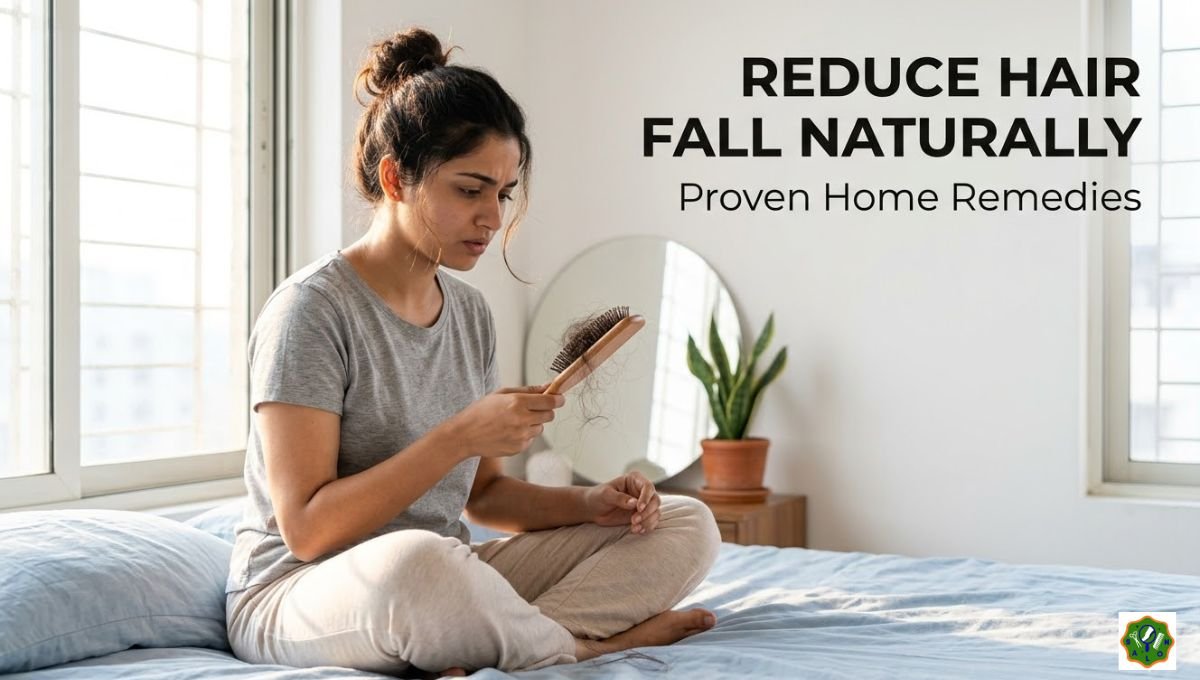
Opening your hairbrush and seeing a thick clump of hair staring back at you is one of those small moments that quietly fills you with worry. A few strands here and there is completely normal — most people shed between 50 and 100 hairs a day as part of the natural hair growth cycle. But when the shedding becomes noticeably heavier, when your ponytail feels thinner, when you can see more of your scalp than you used to — that is when it becomes something worth addressing. And it is something millions of people deal with every single day.
The good news is that for most types of hair fall, you do not need to spend money on expensive salon treatments or aggressive chemical products right away. Learning how to reduce hair fall naturally at home using proven ingredients and smart habits can make a real and visible difference — often within just a few weeks of consistent effort. This guide covers the most effective, science-supported home remedies, the dietary changes that fuel healthy hair from the inside, and the daily habits that quietly protect every strand on your head.
How to Reduce Hair Fall Naturally at Home
Before you try any remedy, it helps to understand why your hair is falling in the first place. The most common causes of hair fall include nutritional deficiencies — especially low levels of protein, iron, zinc, and certain vitamins. Chronic stress triggers a condition called telogen effluvium, which pushes a large number of hair follicles into a resting and shedding phase at once. Hormonal imbalances from conditions like thyroid dysfunction or PCOS are another major factor. Genetics, harsh hair products, heat styling, and scalp infections all play a role too.
Home remedies are most effective when they target one or more of these root causes — nourishing the scalp, improving blood circulation to follicles, strengthening hair from within, and reducing inflammation. With that foundation in mind, here are the most reliable natural remedies available.
Image Description: A realistic flat-lay of natural hair fall remedy ingredients on a rustic wooden surface — a fresh aloe vera leaf cut open, a small bowl of coconut oil, halved onion, fenugreek seeds, and a bottle of rosemary essential oil — soft warm lighting, representing a complete home hair care toolkit.
Remedy 1: Scalp Massage — The Simplest and Most Underrated Fix
If there is one thing every dermatologist agrees on, it is this: regular scalp massage is safe, free, and genuinely effective. Studies show that simply massaging your scalp can help increase the thickness of your hair by boosting blood flow to the hair follicles, which improves nutrient delivery and oxygenation.
Better blood flow means more of what your follicles need — oxygen, protein, vitamins — reaches them consistently. The result over time is stronger, thicker strands and reduced shedding.
How to Do It
Use your fingertips — not your nails — to apply gentle circular pressure across your entire scalp for four to five minutes daily. You can do this on dry hair before washing, or while applying oil. Dr. Jennifer Ashton of ABC News confirms that using your own fingers is equally effective as any scalp massager tool on the market. For best results, do this every day before your morning shower or before bed.
Remedy 2: Rosemary Oil — The Natural Alternative to Minoxidil
Rosemary oil is one of the most exciting natural hair fall remedies backed by science. At least one well-cited study found that rosemary oil is similarly effective as the over-the-counter hair-growth medication minoxidil — commonly sold as Rogaine — in promoting hair growth over a six-month period. That is a remarkable finding, and it has made rosemary oil one of the most recommended natural options by dermatologists for people with mild to moderate hair thinning.
Rosemary oil works by improving circulation to the scalp and reducing inflammation around hair follicles — two of the primary drivers of hair thinning and loss.
How to Use It
Mix four to five drops of rosemary essential oil with one tablespoon of a carrier oil such as coconut oil, jojoba oil, or olive oil. Massage it vigorously into your scalp for two to three minutes to maximize absorption and blood flow. Leave it on for at least one hour — or overnight for deeper benefit — then wash out with a gentle shampoo. Use this two to three times a week for consistent results. Never apply undiluted essential oils directly to the scalp, as this can cause irritation.
Image Description: A small dark glass bottle of rosemary essential oil surrounded by fresh rosemary sprigs on a white marble surface, with a dropper resting beside it and warm, clean lighting — representing a natural and science-backed hair fall remedy.
Remedy 3: Onion Juice — The Smelly Remedy That Actually Works
Onion juice is one of those home remedies that people dismiss because of the smell — but the science behind it is surprisingly solid. According to a study published in the Journal of Dermatology, topical application of crude onion juice to the scalp can aid hair regrowth, especially in cases of alopecia areata, a common autoimmune hair loss condition.
Onion juice is great for hair due to its rich sulfur content that promotes blood circulation to the hair follicles, reduces irritation and inflammation, and regenerates hair follicles. It also contains antibacterial properties that treat scalp infections.
How to Use It
Take one medium onion, blend it, and strain the mixture through a fine cloth or strainer to extract the juice. Using a cotton ball or your fingertips, apply the juice directly to your scalp. Gently massage it in for a few seconds. Leave it on for 30 to 60 minutes — the longer, the better — then rinse thoroughly with a mild shampoo. Use this one to two times per week. The smell dissipates completely once the hair is washed. You can mix two tablespoons of onion juice with one tablespoon of aloe vera gel and one tablespoon of olive oil for a more nourishing version that is also gentler on the scalp.
Remedy 4: Aloe Vera — Calm the Scalp and Unblock Follicles
Aloe vera is one of the most widely used and broadly beneficial natural hair care ingredients available. Aloe vera’s soothing and hydrating properties can promote scalp health, balance pH levels, reduce inflammation, and support hair growth.
One of the key reasons hair follicles stop producing hair efficiently is excess oil buildup and dandruff that physically blocks the follicle opening. Aloe vera clears this blockage while simultaneously soothing any scalp irritation or inflammation that may be contributing to hair fall.
How to Use It
If you have an aloe vera plant at home, cut a leaf and scoop out the fresh gel using a spoon. Apply it directly to your scalp and spread it through the lengths of your hair. Leave it on for 30 to 60 minutes, then rinse with lukewarm water and a mild shampoo. Use this two to three times a week. Store-bought pure aloe vera gel works equally well — just check that it contains minimal additives or alcohol, as these can have the opposite effect on scalp health.
Remedy 5: Fenugreek Seeds — Feed Your Follicles From the Outside In
Fenugreek seeds — known as methi in Hindi — have been used in Ayurvedic hair care for centuries, and modern research has begun to validate why. Fenugreek seeds are rich in proteins, vitamins, and minerals. They include proteins, nicotinic acid, lecithin, and other compounds that can help strengthen hair, increase hair development, and minimize hair fall. They also aid in the maintenance of a healthy scalp.
Nicotinic acid in particular has been shown to improve blood circulation in the scalp, which feeds follicles and stimulates growth. Lecithin adds moisture to dry, brittle strands and reduces breakage.
How to Use It
Soak two tablespoons of fenugreek seeds in water overnight. The next morning, drain the water and grind the seeds into a smooth paste. You can mix in a small amount of yogurt or coconut oil to improve the texture. Apply the paste to your scalp and work it through the roots of your hair. Leave it on for one hour, then rinse with a mild shampoo. Use this once or twice per week. Some people also add a tablespoon of ground fenugreek powder to smoothies or warm water as an internal supplement for hair health.
Image Description: A small white bowl of soaked fenugreek seeds beside a stone mortar and pestle, with a ground fenugreek paste on a banana leaf, set on a dark wooden surface — representing a traditional and effective Ayurvedic home remedy for hair fall.
Remedy 6: Coconut Oil — Protect the Shaft and Strengthen the Root
Coconut oil is one of the most studied natural oils for hair care. Unlike many other oils that coat only the surface of the hair, coconut oil is able to penetrate deep into the hair shaft because of its unique molecular structure — specifically, its high concentration of lauric acid, a medium-chain fatty acid. Coconut oil can penetrate deep into your hair shafts and prevent protein loss. This helps reduce hair damage and breakage often caused by physical trauma like harmful hair styling techniques and the use of harsh products.
While Dr. Jennifer Ashton of ABC News notes that the evidence for dramatic hair growth from coconut oil is limited, she acknowledges that the risk-versus-benefit calculation strongly favors using it — it is safe, affordable, and provides genuine protective benefits even if the growth effect is modest.
How to Use It
Warm two to three tablespoons of pure coconut oil in a small bowl by placing it in warm water for a minute. Apply it to your scalp using your fingertips and massage gently for five to ten minutes. Work the remaining oil through the lengths of your hair. Leave it on for at least one hour — or overnight covered with a shower cap for deeper conditioning. Wash out with a mild shampoo. Use two to three times a week.
Remedy 7: Amla — The Vitamin C Powerhouse for Hair
Indian gooseberry, commonly known as amla, is one of the richest natural sources of Vitamin C and antioxidants available anywhere. Amla supports collagen production and protects hair from oxidative damage. It is one of the best natural sources of Vitamin C and antioxidants, and adding it to your daily health care routine makes your scalp immunity stronger from the roots.
Collagen is a structural protein that makes up part of the hair follicle. Supporting collagen production strengthens the follicle structure, which means hair is more securely anchored in the scalp and less likely to fall out prematurely. Amla also has antifungal properties that help keep the scalp clean and infection-free.
How to Use It
Mix amla powder with coconut oil and warm it gently over low heat for three to four minutes. Allow it to cool slightly, then massage it into the scalp and leave for at least one hour before washing. Alternatively, apply a paste made from amla powder mixed with yogurt directly to the scalp. For internal benefits, drink one tablespoon of fresh amla juice daily — this provides the vitamin C your body needs to support hair follicle health from within. Use the oil treatment once or twice per week.
What to Eat to Stop Hair Fall From the Inside
No topical remedy works as well as it should if your body is not getting the nutrients it needs to build healthy hair. Home remedies are most effective when paired with healthy lifestyle habits: a balanced diet that incorporates protein, iron, omega-3, and vitamins, along with maintaining proper hydration.
Here is what your hair specifically needs from your diet every day:
Protein
Hair is made almost entirely of a protein called keratin. Without enough dietary protein, your body cannot produce strong hair strands, and what it does produce becomes brittle and prone to breakage. Aim to include one good protein source at every meal — eggs, fish, chicken, lentils, beans, tofu, or dairy.
Iron
Iron deficiency is one of the leading causes of hair fall in women, particularly in India and other countries where vegetarian diets are common. Iron helps red blood cells carry oxygen to the scalp and hair follicles. Low iron means less oxygen to the follicle, which slows growth and increases shedding. Good sources include spinach, lentils, chickpeas, pumpkin seeds, and lean red meat. Pair iron-rich foods with Vitamin C — a squeeze of lemon on your dal or spinach — to dramatically improve absorption.
Omega-3 Fatty Acids
Omega-3 fatty acids keep the scalp hydrated, reduce follicle inflammation, and support the health of the cell membranes around each hair follicle. Flaxseeds are a great source of quality omega-3 fiber that nourishes your hair both internally and externally. Other rich sources include walnuts, chia seeds, and fatty fish like salmon and sardines.
Vitamins for Hair
Vitamin D deficiency is strongly linked to hair loss in multiple studies. Biotin (Vitamin B7) supports keratin infrastructure. Vitamin E protects follicles from oxidative stress. These can come from food — fatty fish, eggs, nuts, and seeds — or from a daily multivitamin if your diet is limited. However, avoid over-supplementing, particularly with Vitamin A, which can actually cause hair loss in excess.
Image Description: A colorful, balanced meal spread on a white table — a bowl of lentil soup, grilled salmon, a spinach and walnut salad, sliced eggs, and a glass of amla juice with lemon — representing a hair-healthy diet that reduces fall from within.
Daily Habits That Make or Break Your Hair Health
What you do every day to your hair matters just as much as what you apply to it. Here are the most important protective habits to build into your routine:
Stop the Heat and Chemicals
Blow dryers, flat irons, curling wands, and chemical relaxers or dyes all strip moisture from hair and weaken its structure. If you use heat tools, always apply a heat protectant first and keep the temperature as low as possible. Try air-drying your hair at least three to four days a week.
Be Gentle When Your Hair Is Wet
Wet hair is at its most fragile and elastic — it stretches more and breaks more easily. Never rub wet hair aggressively with a towel. Instead, gently squeeze or pat it dry with a soft microfibre towel or a cotton T-shirt. Use a wide-tooth comb to detangle, starting from the ends and working upward slowly.
Loosen Your Hairstyles
Tight ponytails, braids, and buns create constant pulling tension on the hair shaft and the follicle. Over time, this causes a type of hair loss called traction alopecia, which can become permanent if the tension is not reduced. Wear your hair loose or in gentle, low-tension styles whenever possible.
Manage Your Stress
Stress management through yoga, meditation, or deep breathing exercises is a genuinely important part of reducing hair fall — not just a wellness cliché. Chronic stress pushes a disproportionate number of hair follicles into the shedding phase at once, causing the type of sudden, heavy hair fall that many people experience during or after difficult periods in life. Even five to ten minutes of deep breathing or meditation daily can meaningfully reduce the cortisol levels that drive stress-related hair loss.
Wash Correctly
Washing your hair too frequently strips the scalp of its natural oils, leading to dryness and increased breakage. Washing too infrequently allows oil, product, and dead skin to accumulate and block follicles. For most people, washing two to three times per week with a mild, sulfate-free shampoo is ideal. Always follow with a conditioner applied from mid-length to the ends — never on the roots, as this can weigh the hair down and clog follicles.
How Long Before You See Results?
This is the most important expectation to set correctly. To see visible improvements, most remedies require consistent use for at least 2 to 3 months. Hair grows approximately half an inch per month on average, and the improvement in hair fall happens gradually as more follicles move out of the shedding phase and back into active growth. Do not judge a remedy by one or two uses. Commit to a consistent routine for at least eight weeks before deciding whether it is working.
Take a photo of your hairline and parting every two weeks under the same lighting. This gives you an objective reference point that is more reliable than how your hair feels on any given day.
When to See a Doctor
Home remedies work well for common, lifestyle-related hair fall. But certain types of hair loss require professional medical attention. See a dermatologist if your hair fall is sudden and severe, if you notice patchy bald spots, if your scalp is itchy or inflamed, if hair fall is accompanied by other symptoms like fatigue or unexplained weight changes, or if you have been losing hair consistently for more than six months without improvement despite lifestyle changes.
Conditions like alopecia areata, thyroid disorders, PCOS, and iron deficiency anemia all cause hair fall and require targeted medical treatment. A dermatologist can run a simple blood panel and scalp assessment to identify whether something deeper is going on — and the earlier it is caught, the more easily it is treated.
A Simple Weekly Hair Care Routine to Follow
Here is how to combine all of the best remedies into a realistic weekly schedule:
Monday / Thursday: Scalp massage with rosemary oil mixed in coconut oil — leave for one hour, then wash with mild shampoo
Tuesday / Friday: Aloe vera gel applied to scalp and left for 30 to 60 minutes before washing
Wednesday: Fenugreek seed paste applied for one hour before washing
Sunday: Onion juice treatment — applied for 30 to 60 minutes, then thoroughly washed out
Every day: Scalp massage for four to five minutes — no oil needed, just fingertips. Eat a balanced meal with protein and iron. Drink at least eight glasses of water. Manage stress with even five minutes of breathing or mindfulness.
Final Thoughts
Hair fall is one of those problems that responds very well to consistent, natural care — but only if you understand what you are dealing with and approach it with patience. The remedies in this guide are not quick fixes. They are building blocks for a healthier scalp environment, stronger follicles, and better-nourished hair over time.
If you have been wondering how to reduce hair fall naturally at home, the answer is not one single miracle ingredient — it is a combination of the right topical treatments, the right foods, and the right daily habits working together. Start with two or three remedies this week. Build from there. And give your hair the consistent care it deserves.
Disclaimer: This article is for informational purposes only. Always consult a qualified dermatologist or healthcare professional for persistent or severe hair loss.