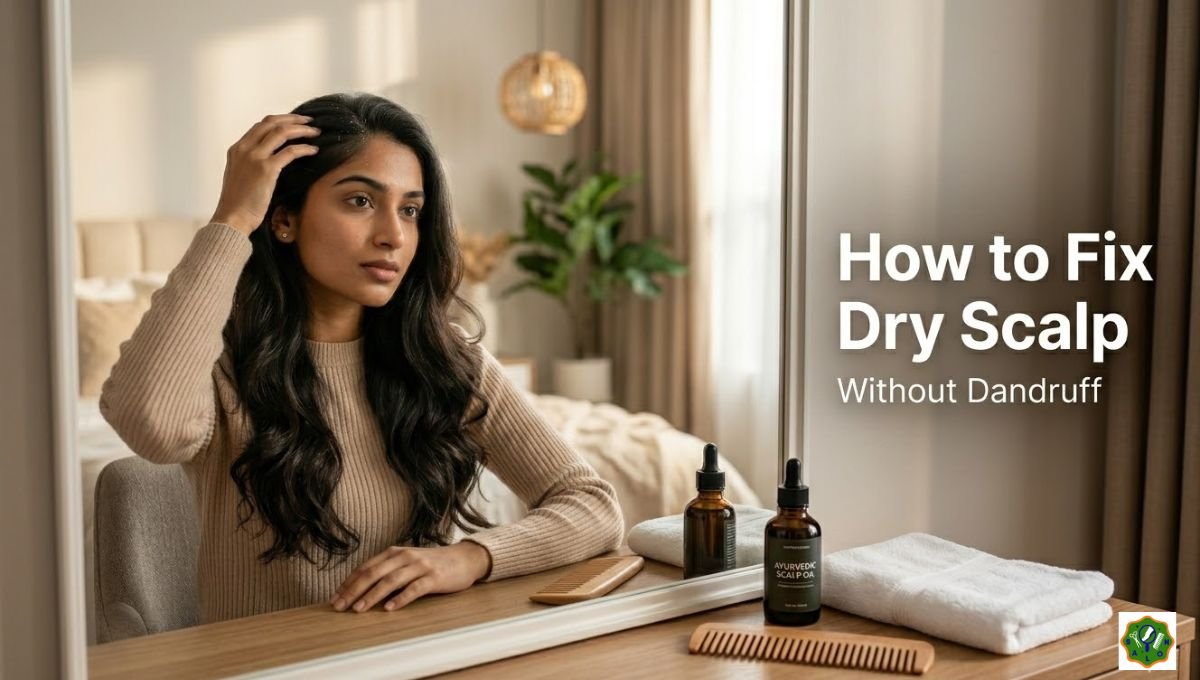
You keep scratching your head. There are small white flakes on your shoulders. Your scalp feels tight, itchy, and uncomfortable — but everyone keeps telling you it must be dandruff. Here is the thing: it might not be dandruff at all. Dry scalp and dandruff look similar on the surface, but they are two completely different conditions caused by completely opposite problems. Treating one with the solution meant for the other will only make things worse.
If your scalp is dry, flaky, and irritated — but not oily or greasy — there is a very good chance you are dealing with a pure moisture problem, not a fungal one. And the good news is that dry scalp without dandruff responds very well to the right home remedies, simple habit changes, and a little patience. This guide covers everything you need to know: what is actually causing your dry scalp, how to tell it apart from dandruff with certainty, and the most effective ways to fix it — naturally, gently, and for good.
How to Fix Dry Scalp Without Dandruff: First, Know the Difference
Before reaching for any product or remedy, it is critical to confirm what you are actually dealing with. Mixing up dry scalp and dandruff is one of the most common hair care mistakes people make — and it leads to treatments that make the problem worse, not better.
Dry Scalp vs. Dandruff — How to Tell Them Apart
Dry scalp occurs when the skin on your head loses too much moisture or does not produce enough natural oil. The symptoms are a tight, itchy feeling on the scalp, small dry white flakes that tend to fall off easily, and no oiliness or greasiness at the root of the hair.
Dandruff, on the other hand, is caused by an overgrowth of a yeast-like fungus called Malassezia, which naturally lives on everyone’s scalp. When it grows too fast, it causes the skin to shed cells rapidly, producing flakes that are larger, oilier, and often yellowish or off-white in colour. The scalp with dandruff typically feels oily or greasy, not dry and tight.
The clearest test is this: look at your flakes. If they are small, dry, and bright white — and your scalp feels uncomfortably tight — that is dry scalp. If the flakes are larger, somewhat sticky, and your roots feel oily even soon after washing — that is dandruff.
Treating them the same way is like using acne cream for dry skin — not a great idea. Anti-dandruff shampoos are designed to reduce oil and fight fungus. Using them on a genuinely dry scalp will strip away what little moisture remains and make your dryness significantly worse.
What Causes Dry Scalp Without Dandruff?
Dry scalp can be triggered by several different factors, and identifying the one that applies to you makes treatment far more targeted and effective.
Harsh Hair Products
Shampoos that contain sulphates, alcohol, or artificial fragrances are among the most common culprits. These ingredients are powerful cleansers — but they are too powerful for many people. They strip the scalp of its natural oils along with the dirt and buildup they are meant to remove. If your scalp started feeling dry after switching to a new shampoo, this is very likely the cause.
Washing Too Frequently
Every time you wash your hair, you remove some of the natural sebum that keeps your scalp moisturised. For people with sensitive or naturally dry scalps, washing every day — or even every other day — removes oil faster than the scalp can replace it. The result is persistent dryness that no amount of conditioner fully corrects.
Hot Water
Hot showers feel luxurious, but hot water strips the scalp’s moisture barrier just like harsh shampoo does. The scalp skin is thin and sensitive, and repeated exposure to hot water weakens its ability to retain moisture over time. Even people who use the right shampoo can develop a chronically dry scalp if they consistently shower in water that is too hot.
Cold Weather and Low Humidity
In winter, cold air outside and heated air indoors both dramatically reduce the humidity in your environment. Your scalp loses moisture to this dry air continuously throughout the day. This is why many people notice their scalp gets worse in the winter months and improves naturally as the seasons change.
Dehydration and Poor Diet
Your scalp is skin — and like all skin, it reflects your internal hydration levels. Not drinking enough water throughout the day shows up on your scalp as dryness and tightness. A diet low in healthy fats, zinc, vitamin E, and omega-3 fatty acids also reduces the body’s ability to produce the natural oils that keep the scalp moisturised from within.
Underlying Skin Conditions
Less commonly, persistent dry scalp that does not respond to home treatment may be linked to a skin condition. Seborrheic dermatitis, scalp eczema, scalp psoriasis, and tinea capitis — a fungal infection — can all present with dryness and flaking. These conditions require specific medical treatment and should be assessed by a dermatologist if home remedies do not produce improvement within four to six weeks.
8 Effective Ways to Fix Dry Scalp Without Dandruff
1. Switch to a Sulphate-Free, Moisturising Shampoo
This is the single most impactful change most people can make, and it should be your very first step. Look for shampoos that are specifically free of sulphates (SLS and SLES), parabens, and artificial fragrance. Instead, look for hydrating ingredients on the label — glycerin, aloe vera, allantoin, ceramides, panthenol, or hyaluronic acid. These ingredients attract and retain moisture in the scalp skin rather than stripping it away.
Use the new shampoo consistently for at least two to three weeks before evaluating whether it is working. Scalp skin has a repair cycle of roughly two to four weeks, so results do not appear overnight.
2. Wash Your Hair Less Often
If you are washing your hair every day, try extending to every two to three days. If you wash every two days, try every three. Each time you skip a wash, you give your scalp an extra day to rebuild its natural oil layer. For many people, simply reducing wash frequency is enough to resolve mild dry scalp on its own without any other changes.
On the days between washes, if your roots feel oily, use a tiny amount of dry shampoo at the roots only — not on the scalp — to absorb excess oil without stripping the scalp skin further.
3. Use Coconut Oil as a Pre-Wash Scalp Treatment
Coconut oil is one of the most well-studied natural moisturisers for scalp health. A 2021 study published in Scientific Reports found topical coconut oil to be an effective treatment for dry scalp, supporting the scalp’s natural microbiome and improving hydration. It works by penetrating the skin surface and providing both moisture and a protective layer that slows moisture loss.
Warm two to three tablespoons of pure coconut oil in a small bowl. Using your fingertips, apply it directly to your scalp in sections and massage gently for two to three minutes. Put on a shower cap and leave it on for at least 30 minutes — or overnight for a more intensive treatment. Then wash out with your gentle, sulphate-free shampoo. Use this treatment once or twice a week.
4. Apply Aloe Vera Gel Directly to the Scalp
Aloe vera is one of the most effective natural ingredients for soothing a dry, irritated scalp. Research published in a 2024 dermatology journal confirmed that aloe vera is effective at reducing scalp irritation and improving hydration. It soothes inflammation, balances the scalp’s pH level, and provides a layer of moisture that absorbs quickly without leaving grease behind.
Scoop fresh gel from an aloe vera leaf or use a pure, additive-free store-bought gel. Apply it directly to your scalp, parting your hair in sections to ensure full coverage. Leave it on for 30 to 60 minutes, then rinse with cool water and a gentle shampoo. Use two to three times per week for consistent improvement.
5. Try a Jojoba Oil Scalp Massage
Jojoba oil is unique among natural oils because its molecular structure is chemically very similar to the skin’s own sebum. This makes it exceptionally compatible with scalp skin — it moisturises without clogging follicles and absorbs quickly without leaving a heavy residue. Jojoba oil also has anti-inflammatory properties that can help reduce the redness and sensitivity that often accompany a dry scalp.
Apply a small amount — about half a teaspoon — directly to your fingertips and massage it gently into your scalp for three to five minutes. You can leave it on as a light overnight treatment or wash it out after 30 minutes. Unlike coconut oil, jojoba oil is light enough to use as a leave-in scalp serum for people with fine hair without weighing strands down.
6. Use an Apple Cider Vinegar Rinse
Apple cider vinegar works differently from oils and moisturisers. Its role is to gently exfoliate dead skin cells from the scalp surface, restore the scalp’s natural acidic pH, and remove residue from styling products and hard water that can build up and interfere with moisture absorption. When the scalp surface is clearer and its pH is balanced, it retains moisture more efficiently.
Mix one part apple cider vinegar with two parts water in a spray bottle or a small cup. After shampooing, apply the mixture to your scalp and massage gently. Leave it on for five to ten minutes, then rinse thoroughly with cool water. Use this once a week — not more, as overuse can over-exfoliate the scalp and create a new kind of irritation.
7. Add a Weekly Deep Conditioning Treatment
Your scalp and hair lengths both benefit from a weekly deep conditioning session. A deeply nourishing hair mask — applied to clean, damp hair — restores moisture to the scalp and shaft simultaneously. Look for masks that contain ingredients like shea butter, argan oil, avocado oil, or keratin.
Apply the mask after shampooing, parting your hair into sections and applying it generously from root to tip. Cover with a shower cap and leave it on for at least 20 to 30 minutes before rinsing with cool water. Deep conditioning treatments are most effective when the heat from your head can activate the ingredients, which is why a shower cap makes a meaningful difference to the results.
8. Add Tea Tree Oil for Itch Relief
If your dry scalp is accompanied by persistent itching, tea tree oil is one of the most effective natural options for quick relief. Tea tree oil has antimicrobial and anti-inflammatory properties that calm scalp irritation and reduce the urge to scratch — which is important because scratching damages the skin barrier and worsens dryness over time.
Never apply tea tree oil directly to the scalp without diluting it first. Mix four to five drops with one tablespoon of coconut oil or jojoba oil and massage it into the scalp. Leave for 10 to 20 minutes, then wash out. You can also add a few drops to your regular shampoo each time you wash. Use this two to three times per week when itching is a problem, and reduce frequency once symptoms improve.
Lifestyle Changes That Fix Dry Scalp From the Inside
Home remedies applied to the scalp work best when supported by internal changes that address the root cause of dryness from within.
Drink More Water
Your scalp is skin, and skin hydration depends directly on how much water you drink throughout the day. Aim for at least six to eight glasses of water daily. If your scalp dryness is connected to general dehydration, improving your water intake can produce noticeable improvement in scalp moisture within two to three weeks.
Eat More Healthy Fats
Omega-3 fatty acids play a direct role in the body’s ability to produce natural skin oils. A diet low in healthy fats results in reduced sebum production, which translates to a drier scalp. Foods rich in omega-3 include walnuts, flaxseeds, chia seeds, salmon, sardines, and avocado. Including these in your daily meals supports scalp moisture from the inside out in a way that no topical treatment can fully replace.
Load Up on Key Vitamins and Minerals
Certain nutrients are essential for scalp health. Vitamin E protects the skin from oxidative stress and helps retain moisture. Biotin supports the structure of the skin and hair follicle. Zinc regulates oil production. Vitamin D deficiency is linked to multiple scalp conditions including dry skin. A diet rich in eggs, leafy greens, nuts, seeds, and fatty fish covers most of these needs. If your diet is limited, a broad daily multivitamin can help fill the gaps.
Reduce Sugar and Processed Food
A diet high in sugar has been linked to an imbalance in the scalp’s microbiome — the community of bacteria and fungi that live on healthy scalp skin. When this balance is disrupted by excess sugar intake, the scalp environment becomes less stable and more prone to dryness, irritation, and skin cell shedding. Reducing processed food and added sugar is a low-cost, high-impact change that supports scalp health alongside everything else.
Simple Daily and Weekly Habits for a Healthier Scalp
Lower Your Shower Temperature
Switch from hot to lukewarm water for washing your hair and scalp. This one change alone can significantly reduce moisture stripping. You do not need cold water — just avoid the temperature that makes the shower feel like a sauna.
Sleep on a Silk or Satin Pillowcase
Cotton pillowcases absorb moisture from your skin and hair as you sleep. Switching to silk or satin reduces this moisture loss significantly, which benefits both your scalp and hair shaft health overnight.
Use a Humidifier in Winter
If you live in a cold climate or spend a lot of time in heated indoor spaces, adding a humidifier to your bedroom or workspace restores moisture to the air and reduces how much moisture your scalp loses to the environment throughout the day. Even a small, inexpensive humidifier can produce noticeable results within a week or two.
Be Gentle With Heat Styling
Heat styling tools — blow dryers, flat irons, and curling wands — draw moisture out of the scalp and hair shaft. Use them on the lowest effective heat setting, always apply a heat protectant first, and try to air-dry your hair at least three to four days a week. If you use a blow dryer daily, consider switching to one with a cool-shot setting and using it for the final minute of drying to seal the scalp skin rather than continue stripping it.
Rinse Out Shampoo Thoroughly
Shampoo residue left on the scalp is a surprisingly common cause of irritation, itching, and dryness. After washing, spend an extra minute rinsing until the water runs completely clear and there is no slippery feeling left on the scalp. Leftover shampoo disrupts the scalp’s pH and weakens its moisture barrier over time.
A Simple Weekly Routine for Dry Scalp Relief
Here is how to combine all of the most effective changes into a realistic weekly routine:
Wash Day (2–3 times per week): Apply coconut oil or jojoba oil to the scalp 30 minutes before washing. Shampoo with a sulphate-free, moisturising shampoo using lukewarm water. Rinse thoroughly until water runs clear. Apply a deep conditioning mask from root to tip. Rinse with cool water. Leave in a small amount of aloe vera gel while the hair is still damp.
Between Wash Days: Massage the scalp gently with fingertips for three to five minutes each morning — no product needed. Mist the scalp lightly with water if it feels tight. Avoid scratching, even when the itch feels intense.
Once a Week: Use an apple cider vinegar rinse after shampooing to exfoliate and rebalance scalp pH. Apply a tea tree oil and coconut oil blend if itching has been persistent.
Every Day: Drink at least six to eight glasses of water. Include one omega-3 rich food in your meals. Use a silk pillowcase and avoid excessive heat styling.
How Long Does It Take to See Results?
Most mild cases of dry scalp begin to improve within two weeks of consistent care. More persistent dryness often takes a full four to six weeks to respond significantly — especially if the problem has been building for a long time. The scalp skin renews itself on a cycle of approximately four weeks, so real structural improvement takes at least one full cycle to become visible.
The key is consistency. Trying one remedy for three days, switching to another, and then abandoning it entirely is the reason most people feel like nothing works. Pick two or three approaches, commit to them daily for at least four weeks, and track how your scalp feels — not just how it looks, because internal improvement often comes before visible changes.
When to See a Dermatologist
See a dermatologist if your dry scalp has not improved after four to six weeks of consistent home treatment, if the skin on your scalp is red, inflamed, or develops sores from scratching, if the dryness is accompanied by significant hair fall, if the flaking is severe and widespread, or if you notice any patches of thickened or scaly skin that feel different from the rest of your scalp. These signs may indicate an underlying condition like psoriasis, eczema, or a fungal infection that requires a targeted prescription treatment.
Final Thoughts
Dry scalp without dandruff is one of the most common and most misunderstood scalp conditions — and it is also one of the most straightforward to fix once you understand what is actually causing it. The solution is not anti-dandruff shampoo. It is not stripping products or harsh treatments. It is gentleness, moisture, the right natural ingredients, and habits that protect the scalp’s natural moisture barrier rather than depleting it.
Start with the simplest changes first: switch your shampoo, lower the shower temperature, and add a weekly coconut oil treatment. Build from there as your scalp responds. Most people who commit to this approach consistently see a real and lasting difference within a month — and wonder why they spent so long reaching for the wrong products.
Disclaimer: This article is for informational purposes only. For persistent or severe scalp conditions, please consult a qualified dermatologist.